The Emirates
The United Arab Emirates consists of seven emirates. In addition to the capital, Abu Dhabi, and the economic hub, Dubai, these are Sharjah, Fujairah,Ras Al Khaimah, Ajman, and Umm Al Quain. There are 10.7 million people living in the Emirates, 90% of whom are foreigners. The largest groups among the foreigners are Indians and Pakistanis.
Dubai occupies a unique strategic position. Located along a major trade route connecting Europe, Asia, and Africa, Dubai has become a key hub for international trade and logistics.
In the 1990s, Dubai's economy was heavily dependent on oil. Today, oil and gas account for less than 1% of GDP, as the city has successfully diversified its economy.
Dubai has specialized in tourism, real estate, trade, technology, and logistics. Major projects such as the Jebel Ali Port (one of the largest man-made ports) and the free trade zones have made the city an attractive destination for foreign investors.
Dubai is known worldwide for its luxury, modern architecture (e.g., the Burj Khalifa), and attractions such as the artificial islands.
Dubai is one of the region's financial hubs, is investing heavily in future technologies such as AI, and is also known for its ongoing real estate boom.
Project 2040
The long-term development plan, the “Dubai 2040 Urban Master Plan,” aims to make Dubai one of the most sustainable and livable cities in the world.
The following priorities will be pursued:
- A 60% increase in green space.
- New residential and recreational areas.
- Promotion of renewable energy and sustainable construction practices.
- Expansion of autonomous transportation systems.
As part of the project, both the population and GDP are expected to double. Education and healthcare infrastructure are expected to grow by a quarter.
In addition, there is massive economic support for the development of innovation centers and technology zones, with a particular focus on investments in future technologies. These include, above all:
- Artificial Intelligence (AI) – Dubai was one of the first cities to appoint an AI minister and is investing heavily in AI solutions.
- Blockchain – The goal is to become the world's first blockchain-based government.
- Renewable Energy. The Mohammed bin Rashid Al Maktoum Solar Park is a prime example of Dubai's commitment to green energy.
- Autonomous mobility. By 2030, 25% of vehicles are expected to be autonomous.
Projects such as the Mars colonization initiative (Vision 2117) and the Emirates Mars Mission (“Hope Probe”) underscore Dubai’s ambitions in space exploration.
Financial/Trading Center
With the Dubai International Financial Center (DIFC), Dubai is a leading financial center in the Middle East. Dubai provides a platform for international banks, investment firms, and companies.
Dubai is a global leader in Islamic banking and Sharia-compliant financial products. Its attractive tax policies and tax exemptions for businesses and individuals make Dubai appealing to investors and talent worldwide.
Dubai is a global venue for major conferences and trade shows. These include, among others:
- Gitex Global—One of the leading technology trade shows for AI, blockchain, and cloud computing.
- Arab Health – One of the world's largest healthcare trade shows.
- World Government Summit – A platform for global government leaders and experts.
- The Dubai Airshow – A showcase of the latest developments in aviation.
- Expo 2020 (2021) – A milestone in Dubai’s history that promoted innovation and international cooperation.
Free Zone
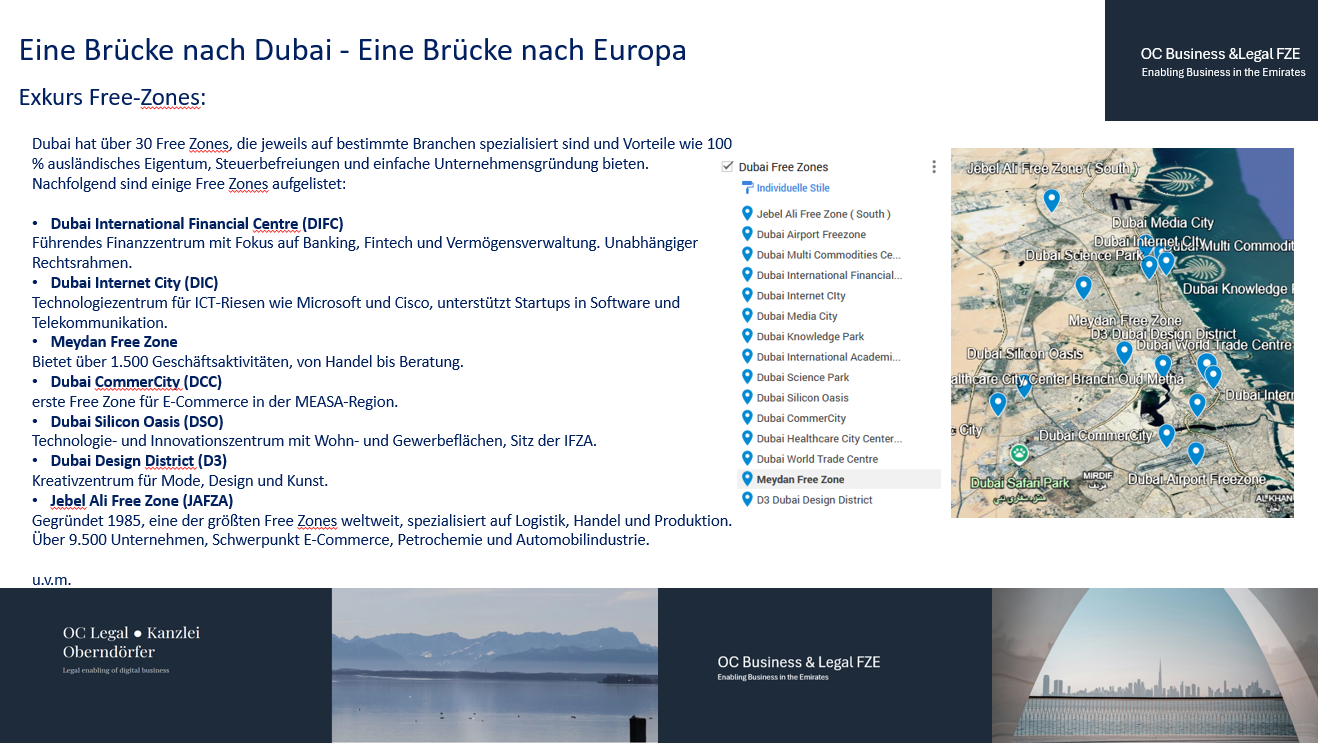
Free zones are among the most important location models in the United Arab Emirates. They were created to attract international companies and offer different focuses depending on the location – for example, trade, services, technology or media.
Each Free Zone has its own authorities, licensing models, and regulatory requirements. Therefore, the conditions for setting up a business, operating, and expanding can differ significantly. Choosing the right Free Zone should therefore not be based on price, but rather on your business model, your customers, and your long-term business goals.
We support companies in selecting the appropriate Free Zone, structuring their business activities legally, and coordinating the establishment together with our local partners.
Mainland or Free Zone?
Which corporate structure suits your business model?
One of the first decisions when entering the United Arab Emirates market is choosing between setting up a business on the mainland or in a free zone. Both models offer different advantages and are suited to different business models.
While free zones often offer attractive conditions for internationally active companies, a mainland company frequently opens up greater opportunities for direct business operations within the United Arab Emirates. Which structure is right for you depends on factors such as your customers, your sales force, your employees, and your expansion plans.
Together with you, we analyze your goals and develop a corporate structure that fits your business model and international focus.
Quality of Life
Dubai's high standard of living is reflected in its excellent infrastructure, first-class healthcare, and safe environment. This attracts many expats, who make up nearly 90% of the population.
People from over 200 countries live and work in Dubai, making the city culturally diverse and giving it a cosmopolitan feel. Luxury shopping, world-class restaurants, desert safaris, and water sports are among the many recreational activities available.
Wealthy people move to cities and countries that offer quality of life, safety, and business opportunities. In 2024, the United Arab Emirates (UAE) attracted nearly 7,000 millionaires, placing it ahead of the United States, Singapore, and Canada in the global rankings.
Real Estate
Dubai's high standard of living is reflected in its excellent infrastructure, first-class healthcare, and safe environment. This attracts many expats, who make up nearly 90% of the population.
People from over 200 countries live and work in Dubai, making the city culturally diverse and giving it a cosmopolitan feel. Luxury shopping, world-class restaurants, desert safaris, and water sports are among the many recreational activities available.
Wealthy people move to cities and countries that offer quality of life, safety, and business opportunities. In 2024, the United Arab Emirates (UAE) attracted nearly 7,000 millionaires, placing it ahead of the United States, Singapore, and Canada in the global rankings.
Artificial Intelligence (AI)
The United Arab Emirates (UAE) has set a goal of generating approximately 40% of its gross domestic product through AI by 2031. A $100 billion sovereign wealth fund has been established to finance AI initiatives and attract international talent.
A key element of the strategy is the “Dubai Center for Artificial Intelligence” (DCAI), which supports government agencies in implementing AI technologies.
The “Dubai AI Campus” in the Dubai International Financial Center (DIFC) serves as an innovation hub for AI companies. More than 120 companies have already set up operations there. By 2028, the number of companies is expected to exceed 500, creating more than 3,000 jobs and attracting investments totaling 300 million U.S. dollars.
Starting in the 2025–26 school year, AI will be introduced as a required subject in all public schools in the United Arab Emirates, from kindergarten through 12th grade.
The “One Million Prompters” initiative is an ambitious educational program launched by the Dubai Center for Artificial Intelligence (DCAI). Its goal is to train one million people worldwide in AI prompt engineering and generative AI within three years.
Partners & Network
A strong network of partners is a key factor for success when relocating business operations to Dubai. It not only provides access to local expertise and vital resources but also offers support in navigating the complex legal and cultural requirements. Investing in building and maintaining a network can save time, money, and resources in the long run, while significantly increasing the chances of success.
Dubai offers unique opportunities and possibilities. It is important to engage with Dubai and its culture, traditions, and unique model for success, and to understand its distinctive characteristics. It is essential to have the right contacts. In some cases, this requires years of personal interaction to build a foundation of trust.
To ensure that your entry into this market goes as smoothly as possible for you, we are happy to connect you with our partners, who have built up precisely this kind of network across a wide range of sectors.
Here, we'll introduce you to the most important aspects of networking
Local Knowledge and Expertise
Dubai has a complex regulatory environment, including different requirements for free trade zones and mainland companies. A local partner network can provide valuable insights into the legal, cultural, and business nuances to ensure compliance with all regulations and help avoid potential pitfalls.
- Regulatory Support: Partners can assist with business registration, licensing, and regulatory compliance.
- Market Entry: A network of local consultants, attorneys, and tax experts makes market entry significantly easier
Access to Customers and Business Opportunities
An established network in Dubai opens doors to potential customers, investors, and partners. This is particularly important in a highly competitive market like Dubai, where relationships are often the key to success.
- Business Connections: Local partners can help you establish the right connections, whether with suppliers, customers, or other stakeholders.
- Networking Events: Many partners have access to key industry events and can help you establish yourself in Dubai’s business community.
More Efficient Business Operations
A strong partner network helps accelerate business processes and make them more efficient by providing access to local resources and services.
- Minimize bureaucracy: Local partners know how to deal with government agencies and which documents are required, which significantly reduces the administrative burden.
- Logistical Support: Partners with local connections can assist with logistics, recruitment, and finding suitable offices or production facilities.
Cultural Understanding
In Dubai, understanding the local culture—including business etiquette and traditions—plays an important role. Local partners can help overcome cultural barriers and build long-term relationships.
- Building Trust: Relationships are often based on trust and personal contact. A local partner can serve as a bridge to build trust with business partners.
- Negotiations: Partners with cultural understanding can help during negotiations, prevent misunderstandings, and ensure that your proposals are well received.
Risk Mitigation
A partner network can reduce risk by keeping you informed about potential challenges and proactively offering solutions.
- Market Risks: Partners can help you better assess market risks such as competitive pressure or economic fluctuations.
- Compliance: Working with trusted partners ensures that you always operate in compliance with the law.
Starting a Business
Setting up a business in the United Arab Emirates involves far more than simply applying for a license. Location, company structure, business activities, shareholders, and organizational processes should all be carefully planned in advance.
Depending on the business model, different legal forms, authorities, and licensors may be considered. Structured preparation creates planning certainty and avoids later adjustments.
Together with our local network, we support companies throughout the entire start-up process – from initial planning to the commencement of business operations.
Corporate Structure
The appropriate corporate structure depends on your business model, investment objectives, and international group structure. In addition to traditional operating companies, holding companies, joint ventures, or foundation structures may also be suitable in the United Arab Emirates, depending on the specific circumstances.
Foundations are becoming increasingly important, particularly in asset structuring, business succession, and the long-term protection of family wealth. Whether an operating company, a holding company, or a foundation is the right solution should always be assessed within the overall context of the international corporate and asset structure.
Together with you, we will develop a structure that meets both the requirements in the United Arab Emirates and the regulatory requirements in your home country.
Commercial Law & Licenses
Almost every business activity in the United Arab Emirates requires a suitable license. The required license depends on the planned activity and the chosen location. At the same time, the requirements differ between the mainland and the individual free zones.
Even during the planning phase, it's crucial to determine precisely which activities will be carried out and what regulatory requirements apply. Careful coordination prevents later restrictions or costly changes to the company structure.
We support companies in selecting the appropriate license and accompany the entire approval process together with our local partners.
Work Permit
To work legally in Dubai (United Arab Emirates), foreign nationals need a work visa and a corresponding work permit. This process is typically initiated by the employer and involves several steps. These include, among other things, a health screening—a medical examination at a government-approved health center is required to ensure that the individual does not have any infectious diseases such as HIV or tuberculosis. In addition, a signed employment contract must be in place, detailing the position, salary, and working conditions.
It is also important to note that the work visa is tied to the employer. Changing employers requires applying for a new visa. There are various types of work visas, including temporary, part-time, and project visas. The choice depends on the type of employment. Once the employment relationship ends, the employee generally has 30 days to leave the country or apply for a new visa.
Labor Law
Labor law in Dubai (or, more broadly, in the United Arab Emirates, UAE) is governed by a federal law: the UAE Labor Law, currently Federal Decree Law No. 33 of 2021, which took effect on February 2, 2022. This law applies to the private sector outside the so-called Free Zones, where separate labor regulations may apply in some cases.
Basic Principles of Labor Law in Dubai (UAE).
For example, there are fixed-term and permanent employment contracts. Contracts must be in Arabic (an English version is often provided as well). Regular working hours are a maximum of 8 hours per day and 48 hours per week. Overtime is paid at a premium of 25–50% (50% at night). 30 calendar days of paid annual leave after one year of service. The so-called Free Zones (e.g., DIFC, DMCC, JAFZA)often have their own labor regulations, such as those in the Dubai International Financial Centre (DIFC).
Taxes
The United Arab Emirates offer attractive tax conditions. However, setting up a company in the UAE does not replace tax planning in the home country.
Establishing a company in the United Arab Emirates does not automatically eliminate tax liability in Germany. If only activities are relocated or if the company continues to be effectively managed from Germany, tax obligations may still exist in Germany.
International corporate structures should therefore always be planned in conjunction with experienced tax advisors. Only a comprehensive analysis of the actual business activities, management functions, and the international corporate structure allows for a reliable tax assessment.
Typical topics
- Corporate Tax in the UAE
- Value Added Tax (VAT)
- Double taxation
- Location of the management
- Business premises
- UBO (Ultimate Beneficial Owner)
- Transparency register and disclosure obligations
- Bank account and compliance checks (KYC/AML)
- Economic Substance
- International reporting and documentation requirements
OC Legal does not provide tax advice. We support the legal structuring of international corporate structures and work closely with specialized tax advisors in Germany and the United Arab Emirates on tax-related matters.
Inheritance Law and Sharia Law
Dubai’s legal system is based on a dual foundation: on the one hand, codified civil laws; on the other, the principles of Sharia (Islamic law). In recent years, extensive modernizations have been implemented—particularly in the area of family and personal status law, as well as in the decriminalization of certain behaviors. Nevertheless, Sharia continues to play a central role, particularly in family law, in cases involving morally motivated criminal offenses, and in the general ethical foundation of the justice system.
Application in Inheritance Law
In the area of inheritance law, Islamic law continues to apply without restriction to Muslim decedents. The traditional Sharia provisions apply here, under which, in particular, inheritance shares are determined by law (based on the Quran) (e.g., male descendants receive twice the share of female descendants). Other rules concern, for example, beneficiaries entitled to a compulsory share and dispositions made in a will.
Non-Muslims —and, under certain conditions, foreign Muslims residing in the UAE —have the option to opt out of Sharia inheritance law through a so-called “opt-out” provision. However, this requires that a will be drawn up and either notarized or registered with the Dubai International Financial Centre (DIFC) Wills and Probate Registry.
If no corresponding will has been drawn up, Islamic inheritance law applies by default —even for non-Muslim foreigners. This can result in significant differences from the inheritance laws of their home countries.
The Significance of Conflicts of Laws in International Inheritance Law
Caution is warranted, particularly in light of private international law (PIL) —for example, under the EU Succession Regulation (Art. 21 of the EU Succession Regulation).
A clear and legally sound estate plan is essential, particularly when it comes to real estate ownership, business interests, or cross-border family relationships in Dubai.