Die Emirate
Die Vereinigten Emirate setzen sich aus sieben Emiraten zusammen. Neben der Hauptstadt Abu Dhabi, dem Wirtschaftszentrum Dubai sind dies Sharjah, Fujairah, Ras Al Khaimah, Ajman und Umm Al Quain. Es leben 10.7 Mio. Menschen in den Emiraten, davon sind 90% Ausländer. Größte Gruppe unter den Ausländern, sind die Inder und Pakistanis.
Dubai hat eine besondere strategische Position. Dubai liegt an einer bedeutenden Handelsroute, die Europa, Asien und Afrika verbindet, und hat sich zu einem zentralen Knotenpunkt für internationalen Handel und Logistik entwickelt.
In den 1990er Jahren war Dubais Wirtschaft stark von Erdöl abhängig. Heute machen Öl und Gas weniger als 1% des BIP aus, da die Stadt ihre Wirtschaft erfolgreich diversifiziert hat.
Dubai hat sich auf Tourismus, Immobilien, Handel, Technologie und Logistik spezialisiert. Großprojekte wie der Jebel Ali Port (einer der größten künstlichen Häfen) und die Freihandelszonen haben den Standort für ausländische Investoren attraktiv gemacht.
Dubai ist weltweit bekannt für Luxus, moderne Architektur (z. B. Burj Khalifa) und Attraktionen wie die künstlichen Inseln.
Dubai ist einer der Finanzplätze der Region, investiert massiv in Zukunftstechnologien wie KI und ist auch für seinen Fortdauerenden Immobilienboom bekannt.
Projekt 2040
Der langfristige Entwicklungsplan „Dubai 2040 Urban Master Plan“ soll Dubai zu einer der nachhaltigsten und lebenswertesten Städte der Welt machen.
Dabei werden folgende Schwerpunkte verfolgt:
- Erweiterung der Grünflächen um 60%.
- Neue Wohn- und Freizeitgebiete.
- Förderung erneuerbarer Energien und nachhaltiger Bauweisen.
- Ausbau autonomer Transportmittel.
Im Rahmen des Projekts sollen Bevölkerung wie BIP verdoppelt werden. Die Bildungs- und Infrastruktur im Gesundheitswesen sollen um ein Viertel wachsen.
Weiterhin erfolgt massive Wirtschaftsförderung zur Entwicklung von Innovationszentren und Technologiezonen und insbesondere Investitionen in Zukunftstechnologien. Dies sind vor allem:
- Künstliche Intelligenz (KI) – Dubai war eine der ersten Städte mit einem KI-Minister und investiert stark in KI-Lösungen.
- Blockchain – Ziel ist die erste Blockchain-basierte Regierung der Welt.
- Erneuerbare Energien. Der Mohammed-bin-Rashid-Al-Maktoum-Solarpark ist ein Paradebeispiel für Dubais Engagement im Bereich grüner Energie.
- Autonome Mobilität. Bis 2030 sollen 25% der Transportmittel autonom betrieben werden.
Projekte wie die Mars-Kolonisation (Vision 2117) und die Emirates Mars Mission („Hope Probe“) unterstreichen Dubais Ambitionen in der Raumfahrt.
Finanz-/ Handelsplatz
Mit dem Dubai International Financial Centre (DIFC) ist Dubai ein führender Finanzplatz im Nahen Osten. Dubai bietet eine Plattform für internationale Banken, Investmentgesellschaften und Unternehmen.
Dubai ist ein globaler Vorreiter im Bereich des islamischen Bankings und der Scharia-konformen Finanzprodukte. Seine attraktive Steuerpolitik und Steuerfreiheit für Unternehmen und Einzelpersonen macht Dubai für Investoren und Talente weltweit attraktiv.
Dubai ist ein globaler Veranstaltungsort für bedeutende Konferenzen und Messen. Diese sind u.a.
- Gitex Global -Eine der führenden Technologiemessen für KI, Blockchain und Cloud Computing.
- Arab Health – Eine der größten Gesundheitsmessen weltweit.
- World Government Summit – Eine Plattform für globale Regierungsführer und Experten.
- Die Dubai Airshow – Präsentation der neuesten Entwicklungen in der Luftfahrt.
- Expo 2020 (2021) – Ein Meilenstein in Dubais Geschichte, der Innovationen und internationale Zusammenarbeit förderte.
Free Zone
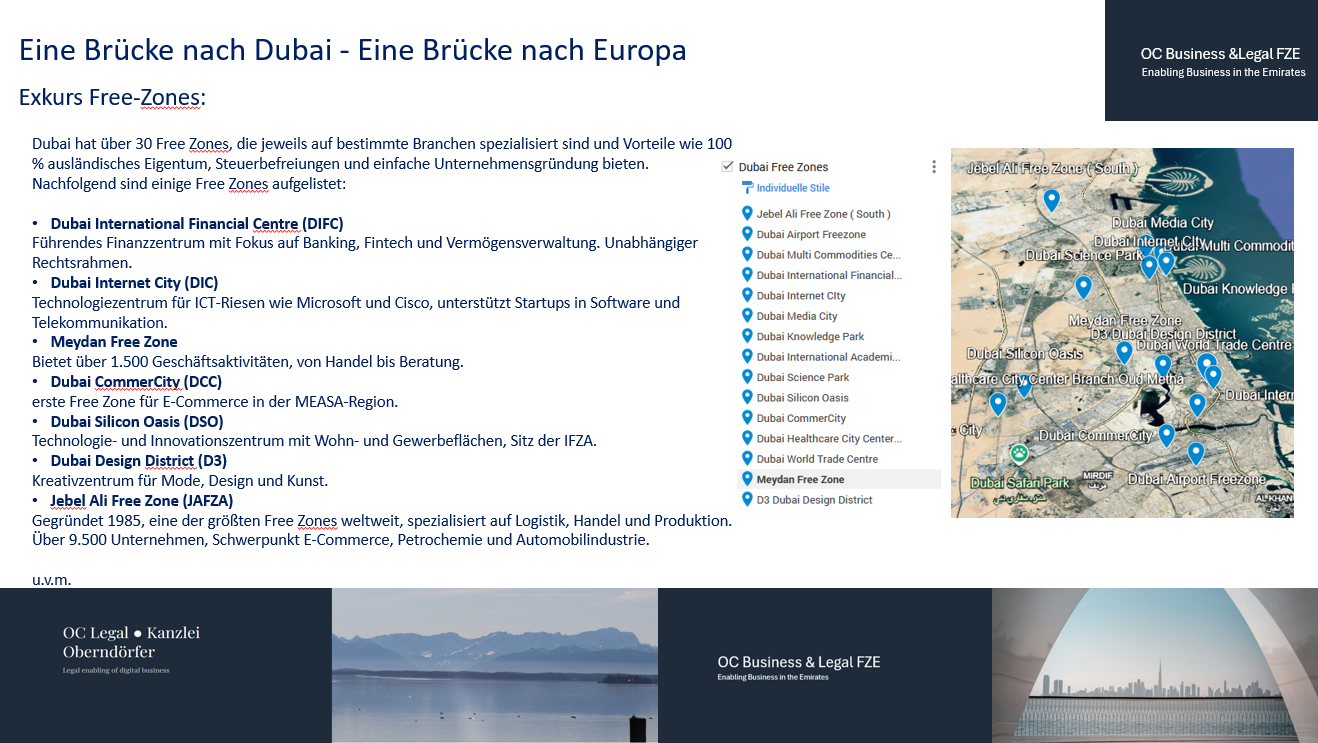
Die Freihandelszonen (Free Zones) gehören zu den wichtigsten Standortmodellen in den Vereinigten Arabischen Emiraten. Sie wurden geschaffen, um internationale Unternehmen anzuziehen und bieten je nach Standort unterschiedliche Schwerpunkte – beispielsweise für Handel, Dienstleistungen, Technologie oder Medien.
Jede Free Zone verfügt über eigene Behörden, Lizenzmodelle und regulatorische Vorgaben. Daher unterscheiden sich die Voraussetzungen für Gründung, Geschäftstätigkeit und Expansion teilweise erheblich. Die Wahl der passenden Free Zone sollte sich deshalb nicht am Preis orientieren, sondern an Ihrem Geschäftsmodell, Ihren Kunden und Ihren langfristigen Unternehmenszielen.
Wir unterstützen Unternehmen bei der Auswahl der geeigneten Free Zone, der rechtlichen Strukturierung ihrer Geschäftstätigkeit und der Koordination der Gründung gemeinsam mit unseren lokalen Partnern.
Mainland oder Free Zone?
Welche Unternehmensstruktur passt zu Ihrem Geschäftsmodell?
Eine der ersten Entscheidungen beim Markteintritt in die Vereinigten Arabischen Emirate ist die Wahl zwischen einer Gründung auf dem Mainland oder in einer Free Zone. Beide Modelle bieten unterschiedliche Vorteile und richten sich an verschiedene Geschäftsmodelle.
Während Free Zones häufig attraktive Rahmenbedingungen für international tätige Unternehmen bieten, eröffnet eine Mainland-Gesellschaft in vielen Fällen größere Möglichkeiten für den direkten Geschäftsbetrieb innerhalb der Vereinigten Arabischen Emirate. Welche Struktur die richtige ist, hängt unter anderem von Ihren Kunden, Ihrem Vertrieb, Ihren Mitarbeitern und Ihren Expansionsplänen ab.
Wir analysieren gemeinsam mit Ihnen Ihre Ziele und entwickeln eine Unternehmensstruktur, die zu Ihrem Geschäftsmodell und Ihrer internationalen Ausrichtung passt.
Lebensqualität
Der Hohe Lebensstandard in Dubai spiegelt sich in der exzellenten Infrastruktur, der erstklassigen Gesundheitsversorgung und dem sicheren Umfeld wider. Dies zieht viele Expats an, die fast 90 % der Bevölkerung ausmachen.
Menschen aus über 200 Nationen leben und arbeiten in Dubai, was die Stadt kulturell vielfältig macht und ihr ein kosmopolitisches Flair verleiht. Luxus-Shopping, erstklassige Restaurants, Wüstensafaris und Wassersport gehören zu den vielen Freizeitmöglichkeiten.
Wohlhabende Menschen ziehen in Städte und Länder, die Lebensqualität, Sicherheit und Geschäftsmöglichkeiten bieten. Die Vereinigte Arabische Emirate (VAE) haben 2024 fast 7000 Millionäre angezogen und lagen im weltweiten Ranking damit vor den Vereinigten Staaten, Singapur und Kanada.
Immobilien
Der Hohe Lebensstandard in Dubai spiegelt sich in der exzellenten Infrastruktur, der erstklassigen Gesundheitsversorgung und dem sicheren Umfeld wider. Dies zieht viele Expats an, die fast 90 % der Bevölkerung ausmachen.
Menschen aus über 200 Nationen leben und arbeiten in Dubai, was die Stadt kulturell vielfältig macht und ihr ein kosmopolitisches Flair verleiht. Luxus-Shopping, erstklassige Restaurants, Wüstensafaris und Wassersport gehören zu den vielen Freizeitmöglichkeiten.
Wohlhabende Menschen ziehen in Städte und Länder, die Lebensqualität, Sicherheit und Geschäftsmöglichkeiten bieten. Die Vereinigte Arabische Emirate (VAE) haben 2024 fast 7000 Millionäre angezogen und lagen im weltweiten Ranking damit vor den Vereinigten Staaten, Singapur und Kanada.
Künstliche Intelligenz (KI)
Die Vereinigten Arabischen Emirate (VAE) haben sich das Ziel gesetzt, bis 2031 rund 40 % ihres Bruttoinlandsprodukts durch KI zu erwirtschaften. Es wurde ein 100 Milliarden US-Dollar schwerer Staatsfonds eingerichtet, um KI-Initiativen zu finanzieren und internationale Talente anzuziehen.
Ein zentrales Element der Strategie ist das „Dubai Centre for Artificial Intelligence“ (DCAI), das Regierungsbehörden bei der Implementierung von KI-Technologien unterstützt.
Der „Dubai AI Campus“ im Dubai International Financial Centre (DIFC) dient als Innovationszentrum für KI-Unternehmen. Bereits über 120 Firmen haben sich dort angesiedelt. Bis 2028 sollen es mehr als 500 Unternehmen sein, die über 3.000 Arbeitsplätze schaffen und Investitionen in Höhe von 300 Millionen US-Dollar anziehen.
Ab dem Schuljahr 2025/26 wird KI als Pflichtfach in allen staatlichen Schulen der Vereinigten Arabischen Emirate eingeführt, beginnend im Kindergarten bis zur 12. Klasse.
Die „One Million Prompters“-Initiative ist ein ehrgeiziges Bildungsprogramm, das vom Dubai Centre for Artificial Intelligence (DCAI) ins Leben gerufen wurde. Ziel ist es, innerhalb von drei Jahren eine Million Menschen weltweit in den Bereichen KI-Prompt-Engineering und generative KI auszubilden.
Partner & Netzwerk
Ein starkes Partnernetzwerk ist ein entscheidender Erfolgsfaktor, wenn man seine Geschäftstätigkeiten nach Dubai verlagern möchte. Es bietet nicht nur Zugang zu lokalem Wissen und wichtigen Ressourcen, sondern auch Unterstützung bei der Navigation durch die komplexen rechtlichen und kulturellen Anforderungen. Die Investition in den Aufbau und die Pflege eines Netzwerks kann langfristig Zeit, Geld und Ressourcen sparen und gleichzeitig die Erfolgschancen erheblich steigern.
Dubai bietet besondere Chancen und Möglichkeiten. Es ist wichtig, dass man sich auf Dubai und seine Kultur, seine Traditionen, und sein spezielles Erfolgsmodell einlassen und seine Besonderheiten verstehen muss. Es ist essentiell, dass man über die richtigen Ansprechpartner verfügt. Dies erfordert teilweise jahrelangen persönlichen Kontakt, um eine vertrauensvolle Basis zu entwickeln.
Um den Schritt bzw. Übertritt in diesen Markt möglichst ohne Reibungsverluste für Sie zu gewährleisten, geben wir Ihnen gerne unsere Partner an die Hand, die genau dieses Netzwerk für die verschiedensten Bereiche aufgebaut haben.
Anbei stellen wir Ihnen die wichtigsten Aspekte des Networking vor
Lokales Wissen und Expertise
Dubai hat ein komplexes regulatorisches Umfeld, einschließlich unterschiedlicher Anforderungen für Freihandelszonen und Festlandunternehmen. Ein lokales Partnernetzwerk kann wertvolle Einblicke in die rechtlichen, kulturellen und geschäftlichen Besonderheiten bieten, um sicherzustellen, dass man alle Vorschriften einhält und potenzielle Fallstricke vermeidet.
- Regulatorische Unterstützung: Partner können bei der Registrierung des Unternehmens, der Lizenzierung und der Einhaltung gesetzlicher Bestimmungen helfen.
- Markteintritt: Ein Netzwerk aus lokalen Beratern, Rechtsanwälten und Steuerexperten erleichtert den Markteintritt erheblich
Zugang zu Kunden und Geschäftsmöglichkeiten
Ein etabliertes Netzwerk in Dubai öffnet Türen zu potenziellen Kunden, Investoren und Partnern. Dies ist besonders wichtig in einem stark wettbewerbsorientierten Markt wie Dubai, wo Beziehungen oft der Schlüssel zum Erfolg sind.
- Geschäftsverbindungen: Lokale Partner können helfen, die richtigen Kontakte zu knüpfen, sei es zu Lieferanten, Kunden oder anderen Stakeholdern.
- Netzwerkveranstaltungen: Viele Partner haben Zugang zu wichtigen Branchenveranstaltungen und können Ihnen helfen, sich in der Geschäftswelt Dubais zu etablieren.
Effizientere Geschäftsabwicklung
Ein starkes Partnernetzwerk trägt dazu bei, Geschäftsprozesse zu beschleunigen und effizienter zu gestalten, indem es Zugang zu lokalen Ressourcen und Dienstleistungen bietet.
- Bürokratie minimieren: Lokale Partner wissen, wie man mit Behörden umgeht und welche Dokumente benötigt werden, was den Verwaltungsaufwand erheblich reduziert.
- Logistische Unterstützung: Partner mit lokalen Verbindungen können bei Logistik, Personalbeschaffung und der Suche nach geeigneten Büros oder Produktionsstätten helfen.
Kulturelles Verständnis
In Dubai spielt das Verständnis der lokalen Kultur, einschließlich der Geschäftsetikette und -traditionen, eine wichtige Rolle. Einheimische Partner können dazu beitragen, kulturelle Barrieren zu überwinden und langfristige Beziehungen aufzubauen.
- Vertrauensbildung: Beziehungen basieren oft auf Vertrauen und persönlichem Kontakt. Ein lokaler Partner kann als Brücke fungieren, um Vertrauen bei Geschäftspartnern aufzubauen.
- Verhandlungen: Partner mit kulturellem Verständnis können bei Verhandlungen helfen, Missverständnisse vermeiden und sicherstellen, dass Ihre Angebote gut aufgenommen werden.
Risikominderung
Ein Partnernetzwerk kann das Risiko reduzieren, indem es Sie über potenzielle Herausforderungen informiert und proaktiv Lösungen bietet.
- Marktrisiken: Partner können helfen, Marktrisiken wie Wettbewerbsdruck oder wirtschaftliche Schwankungen besser einzuschätzen.
- Compliance: Durch die Zusammenarbeit mit vertrauenswürdigen Partnern wird sichergestellt, dass Sie stets gesetzeskonform agieren.
Firmengründung
Die Gründung eines Unternehmens in den Vereinigten Arabischen Emiraten umfasst weit mehr als die Beantragung einer Lizenz. Bereits im Vorfeld sollten Standort, Unternehmensstruktur, Geschäftstätigkeit, Gesellschafter und organisatorische Abläufe sorgfältig geplant werden.
Je nach Geschäftsmodell kommen unterschiedliche Gesellschaftsformen sowie verschiedene Behörden und Lizenzgeber in Betracht. Eine strukturierte Vorbereitung schafft Planungssicherheit und vermeidet spätere Anpassungen.
Gemeinsam mit unserem Netzwerk vor Ort begleiten wir Unternehmen während des gesamten Gründungsprozesses – von der ersten Planung bis zur Aufnahme der Geschäftstätigkeit.
Unternehmensstruktur
Die passende Unternehmensstruktur richtet sich nach Ihrem Geschäftsmodell, Ihren Investitionszielen und Ihrer internationalen Konzernstruktur. Neben klassischen operativen Gesellschaften kommen in den Vereinigten Arabischen Emiraten je nach Anwendungsfall auch Holdinggesellschaften, Joint Ventures oder Stiftungsstrukturen (Foundations) in Betracht.
Foundations gewinnen insbesondere bei der Vermögensstrukturierung, der Unternehmensnachfolge und dem langfristigen Schutz von Familienvermögen zunehmend an Bedeutung. Ob eine operative Gesellschaft, eine Holding oder eine Foundation die richtige Lösung ist, sollte stets im Gesamtkontext der internationalen Unternehmens- und Vermögensstruktur bewertet werden.
Wir entwickeln gemeinsam mit Ihnen eine Struktur, die sowohl den Anforderungen in den Vereinigten Arabischen Emiraten als auch den regulatorischen Vorgaben in Ihrem Heimatstaat gerecht wird
Gewerberecht & Lizenzen
Nahezu jede Geschäftstätigkeit in den Vereinigten Arabischen Emiraten setzt eine passende Lizenz voraus. Welche Lizenz erforderlich ist, richtet sich nach der geplanten Tätigkeit und dem gewählten Standort. Gleichzeitig unterscheiden sich die Anforderungen zwischen Mainland und den einzelnen Free Zones.
Bereits bei der Planung sollte geprüft werden, welche Tätigkeiten tatsächlich ausgeübt werden sollen und welche regulatorischen Vorgaben damit verbunden sind. Eine sorgfältige Abstimmung verhindert spätere Einschränkungen oder kostspielige Änderungen der Unternehmensstruktur.
Wir unterstützen Unternehmen bei der Auswahl der passenden Lizenz und begleiten den gesamten Genehmigungsprozess gemeinsam mit unseren lokalen Partnern.
Arbeitserlaubnis
Um in Dubai (Vereinigte Arabische Emirate) legal zu arbeiten, benötigen ausländische Staatsangehörige ein Arbeitsvisum sowie eine entsprechende Arbeitserlaubnis. Dieser Prozess wird in der Regel vom Arbeitgeber initiiert und umfasst mehrere Schritte. Diese sind u.a. eine Gesundheitsprüfung, eine medizinische Untersuchung in einem von der Regierung anerkannten Gesundheitszentrum ist erforderlich, um sicherzustellen, dass keine ansteckenden Krankheiten wie HIV oder Tuberkulose vorliegen. Außerdem muss ein unterzeichneter Arbeitsvertrag vorliegen, der Details zur Position, zum Gehalt und zu den Arbeitsbedingungen enthält.
Zu beachten ist außerdem: Das Arbeitsvisum ist an den Arbeitgeber gebunden. Ein Wechsel des Arbeitgebers erfordert die Beantragung eines neuen Visums. Es gibt verschiedene Arten von Arbeitsvisa, darunter temporäre, Teilzeit- und Projektvisa. Die Auswahl hängt von der Art der Beschäftigung ab. Nach Beendigung des Arbeitsverhältnisses hat der Arbeitnehmer in der Regel eine Frist von 30 Tagen, um das Land zu verlassen oder ein neues Visum zu beantragen.
Arbeitsrecht
Das Arbeitsrecht in Dubai (bzw. in den Vereinigten Arabischen Emiraten, VAE) wird durch ein bundesweites Gesetz geregelt: das UAE Labour Law, aktuell in der Version Federal Decree Law No. 33 of 2021, das am 2. Februar 2022 in Kraft trat. Dieses Gesetz gilt für den privaten Sektor außerhalb der sogenannten Free Zones, in denen teilweise eigene arbeitsrechtliche Regelungen gelten.
Grundzüge des Arbeitsrechts in Dubai (VAE).
Es gibt z.B. befristete und unbefristete Arbeitsverträge. Verträge müssen in Arabisch vorliegen (eine englische Version ist häufig zusätzlich vorhanden). Die reguläre Arbeitszeit beträgt max. 8 Stunden pro Tag, 48 Stunden pro Woche. Überstunden werden mit einem Zuschlag von 25–50 % (nachts: 50 %) bezahlt. 30 Kalendertage bezahlter Jahresurlaub nach einem Jahr Betriebszugehörigkeit. In den Die sog. Free Zones (z. B. DIFC, DMCC, JAFZA) haben oft eigene arbeitsrechtliche Vorschriften, z. B. im Dubai International Financial Centre (DIFC).
Steuern
Die Vereinigten Arabischen Emirate bieten attraktive steuerliche Rahmenbedingungen. Gleichzeitig ersetzt eine Unternehmensgründung in den UAE keine steuerliche Planung im Heimatstaat.
Eine Gesellschaft in den Vereinigten Arabischen Emiraten führt nicht automatisch dazu, dass in Deutschland keine Steuerpflicht mehr besteht. Werden lediglich Aktivitäten verlagert oder werden Unternehmen weiterhin tatsächlich aus Deutschland geführt, können weiterhin steuerliche Verpflichtungen in Deutschland bestehen.
Internationale Unternehmensstrukturen sollten deshalb stets gemeinsam mit erfahrenen Steuerberatern geplant werden. Nur eine Gesamtbetrachtung der tatsächlichen Geschäftsaktivitäten, der Leitungsfunktionen und der internationalen Unternehmensstruktur ermöglicht eine belastbare steuerliche Beurteilung.
Typische Themen
- Corporate Tax in den UAE
- Mehrwertsteuer (VAT)
- Doppelbesteuerung
- Ort der Geschäftsleitung
- Betriebsstätten
- UBO (Ultimate Beneficial Owner)
- Transparenzregister und Offenlegungspflichten
- Bankkonto und Compliance-Prüfungen (KYC/AML)
- Wirtschaftliche Substanz (Economic Substance)
- Internationale Melde- und Dokumentationspflichten
OC Legal erbringt keine Steuerberatung. Wir begleiten die rechtliche Strukturierung internationaler Unternehmensstrukturen und arbeiten bei steuerlichen Fragestellungen eng mit spezialisierten Steuerberatern in Deutschland und den Vereinigten Arabischen Emiraten zusammen.
Erbrecht und Scharia-Recht
Dubais Rechtssystem basiert auf einer dualen Grundlage: einerseits kodifizierten zivilrechtlichen Gesetzen, andererseits den Prinzipien der Sharīʿah (islamisches Recht). In den letzten Jahren wurden umfangreiche Modernisierungen vorgenommen – insbesondere im Bereich des Personalstatuts (Familien- und Personenrecht) sowie bei der Entkriminalisierung bestimmter Verhaltensweisen. Dennoch behält die Scharia insbesondere im Familienrecht, bei moralisch motivierten Straftatbeständen und im allgemeinen ethischen Fundament der Justiz eine zentrale Rolle.
Anwendung im Erbrecht
Im Bereich des Erbrechts findet das islamische Recht weiterhin uneingeschränkt Anwendung auf muslimische Erblasser. Dabei gelten die klassischen Scharia-Vorschriften, wonach insbesondere die Erbanteile gesetzlich (koranisch) festgelegt sind (z. B. erhalten männliche Nachkommen den doppelten Anteil weiblicher Nachkommen). Weitere Regeln betreffen z.B. Pflichtteilsberechtigte testamentarisch Verfügungen.
Für Nicht-Muslime – und unter bestimmten Voraussetzungen auch für ausländische Muslime mit Wohnsitz in den VAE – besteht die Möglichkeit, sich durch eine sogenannte Opt-Out-Regelung vom Scharia-Erbrecht auszunehmen. Dies setzt jedoch zwingend voraus, dass ein Testament („Will“) verfasst wird, und dieses entweder notariell beurkundet oder beim Dubai International Financial Centre (DIFC) Wills and Probate Registry registriert wird.
Wurde kein entsprechendes Testament errichtet, so wird standardmäßig das islamische Erbrecht angewandt – auch bei nicht-muslimischen Ausländern. Dies kann zu erheblichen Abweichungen von den Erbregelungen der Heimatländer führen.
Bedeutung internationaler Erbrechtskollisionen
Insbesondere im Lichte des internationalen Privatrechts (IPR) – etwa nach der EU-Erbverordnung (Art. 21 EU-ErbVO) – ist Vorsicht geboten.
Gerade bei Immobilienbesitz, Firmenanteilen oder grenzüberschreitenden Familienverhältnissen in Dubai ist eine klare und rechtssichere Nachlassregelung unverzichtbar.